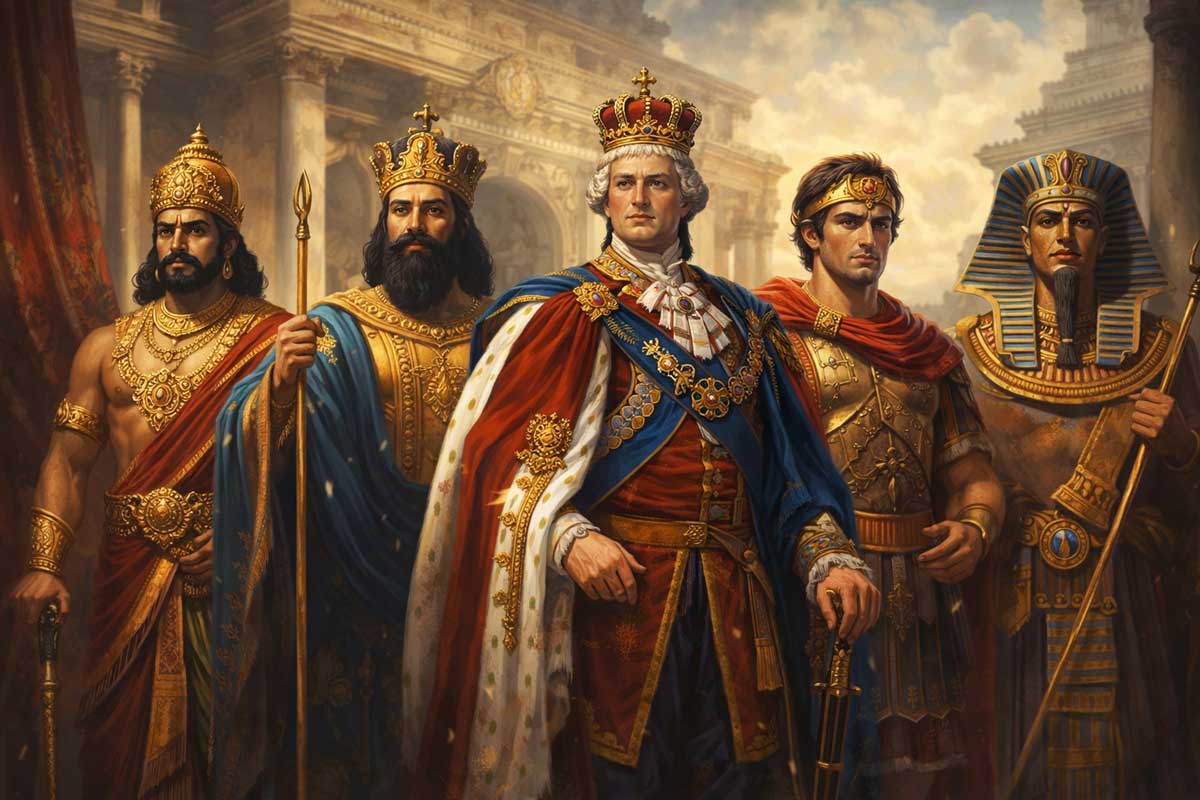
From the Tamil Chola Empire to the Roman and Mongol empires, this interactive table brings together major civilizations from across history. Filter by region, language, or time period to explore how different empires rose, expanded, and influenced the modern world.
| Name | Type | Key Ruler | Years | Present-day Regions | Languages | Parent |
|---|
| Name | Type | Key Ruler | Years | Present-day Regions | Languages | Parent |
|---|
Human history is largely shaped by the rise and fall of powerful empires and the ambitions of extraordinary rulers. From ancient river valley civilizations to vast transcontinental dominions, empires have defined political systems, cultural exchange, language spread, and economic structures across the world. This article provides a structured overview of major ancient empires and the supreme conquerors who led them, tracing how their influence continues to shape modern nations.
The earliest forms of organized power emerged around fertile river systems. The Ancient Egyptian Empire, unified under Narmer around 3100 BCE, developed centralized governance, monumental architecture, and religious systems that lasted for millennia. Alongside Egypt, Mesopotamia saw the rise of the Akkadian Empire under Sargon of Akkad, often considered the first true empire due to its multi-city territorial control.
These early empires established key administrative principles:
The Babylonian Empire, especially under Hammurabi, introduced legal codification, demonstrating that empires were not just military structures but also legal and social systems.
By 600–300 BCE, empires began expanding across continents. The Achaemenid Empire, founded by Cyrus the Great, became one of the first large-scale multicultural empires. It stretched across the Middle East, North Africa, and parts of South Asia. Its success lay in administrative innovation—dividing territories into satrapies while allowing local cultures to remain intact.
Soon after, Alexander the Great of Macedon created a vast empire spanning Greece to India. Though short-lived, his conquests spread Greek culture, creating the Hellenistic world. This marked a shift where empires became vehicles of cultural diffusion.
In India, the Maurya Empire under Ashoka demonstrated a different model. After brutal conquests, Ashoka embraced Buddhism and promoted ethical governance, showing that empire-building could evolve beyond warfare into ideological leadership.
The Roman Empire remains one of the most influential empires in history. At its height, it controlled Europe, North Africa, and parts of the Middle East. Roman achievements in law, engineering, governance, and infrastructure laid the foundation for many modern systems.
Similarly, in East Asia, the Han Dynasty established long-lasting governance structures in China. It expanded trade routes such as the Silk Road, enabling economic and cultural exchange between distant civilizations.
These empires shared key traits:
While global empires expanded, regional civilizations flourished independently. In South India, the Tamil kingdoms—Chera, Chola, and Pandya—developed strong maritime trade networks. The later Chola Empire, under Rajaraja Chola I, became a dominant naval power, extending influence into Southeast Asia.
Unlike land-based empires, the Cholas demonstrated:
In Southeast Asia, the Khmer Empire built monumental architecture like Angkor Wat, reflecting a blend of religion, art, and political power.
In Africa, the Mali Empire, led by Mansa Musa, controlled vast gold resources and trade routes. His famous pilgrimage to Mecca showcased the wealth and global connections of African empires, often underrepresented in mainstream history.
The medieval period witnessed the rise of some of the most formidable conquerors in history. The Mongol Empire, founded by Genghis Khan, became the largest contiguous land empire ever. Its success was driven by:
Despite its reputation for destruction, the Mongol Empire also enabled trade and communication across Eurasia, stabilizing the Silk Road.
Similarly, in the Middle East and South Asia, empires like the Delhi Sultanate and later the Mughal Empire expanded through military strength combined with administrative integration. Under Akbar, the Mughal Empire promoted religious tolerance and cultural synthesis.
The Umayyad and Abbasid Caliphates created vast Islamic empires spanning Spain to Central Asia. These empires were not just political entities but also centers of knowledge, science, and philosophy.
Key contributions include:
The Ottoman Empire, lasting over 600 years, controlled key trade routes between Europe and Asia. It demonstrated longevity through administrative flexibility and military innovation.
The early modern period saw European expansion into global empires. The Spanish Empire and British Empire extended their influence across the Americas, Asia, and Africa.
Unlike earlier empires, these were:
The British Empire, at its peak, became the largest empire in history, influencing language, law, and governance worldwide. English emerged as a global language largely due to this expansion.
Across history, certain figures stand out as supreme conquerors:
Despite differences in geography and time, these leaders shared common traits:
Not all powerful states were empires. Many were kingdoms with strong cultural identities. For example:
Empires typically controlled multiple regions and cultures, while kingdoms often represented a single cultural core.
Modern countries are direct or indirect successors of these empires. Their influence can be seen in:
For example:
The history of empires is not just a record of conquest but a narrative of human organization, ambition, and cultural exchange. From the river valleys of Egypt and Mesopotamia to the vast territories of the Mongols and British, empires have continuously reshaped the world.
Understanding these empires provides insight into how modern civilizations evolved and how power, culture, and innovation intersected across time. Whether through military conquest, trade dominance, or cultural influence, the legacy of these empires and their rulers remains deeply embedded in the global landscape today.