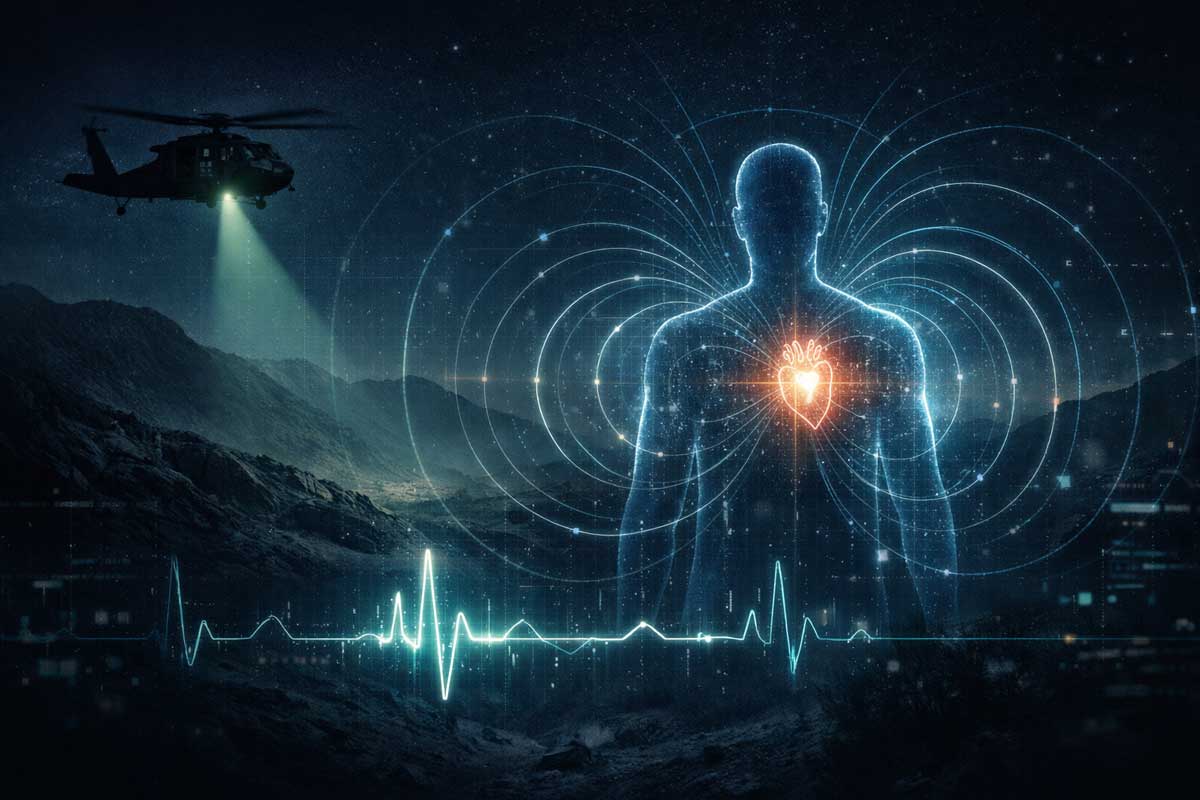
A technical analysis of quantum sensing, magnetocardiography, AI signal processing, and the real physics behind remote human detection claims.
In April 2026, attention turned to a reported breakthrough in U.S. intelligence technology after US President Donald Trump and CIA Director John Ratcliffe hinted at a classified capability used during the recovery of a downed American Air Force officer in southern Iran.
Soon after, media reporting described a system referred to as “Ghost Murmur”, allegedly capable of detecting human heartbeats at long range using quantum magnetometry combined with artificial intelligence signal processing.
“In the right conditions, if your heart is beating, we will find you.”
Another description compared the technology to hearing a voice in a stadium, except the stadium was an enormous desert. It is a dramatic and memorable story. The problem is that, according to scientists familiar with biomagnetism and quantum sensing, the public version of that story is almost certainly not true.
The basic scientific principle is real. Every heartbeat is not only a mechanical event but also an electrical one. As the heart’s muscle cells depolarize and repolarize, they generate:
These magnetic fields are extremely weak. Near the surface of the chest, the heart’s magnetic field is in the range of roughly 10 to 100 picotesla. By comparison, Earth’s magnetic field is around 50 microtesla, which is about a billion times stronger.
Magnetocardiography has been studied for decades. Researchers have used it to investigate heart rhythm abnormalities and cardiac conduction patterns. However, it works only under very specific conditions.
These instruments are designed to exclude as much outside interference as possible. They are not rugged field devices operating across mountain ranges or vast deserts.
The biggest obstacle is not whether the heart produces a magnetic field. It does. The problem is what happens to that field as distance increases.
This means the magnetic field strength drops according to the inverse cube of the distance from the source.
In practical terms, a signal that is barely measurable close to the chest becomes useless at large distances. The laws of field decay are the central reason why long-range heartbeat detection remains implausible.
The phrase “quantum magnetometry” is not invented. Quantum magnetometers are genuine scientific instruments. They can be extremely sensitive and are part of active research in medicine, materials science, and precision sensing.
Modern examples include:
These tools can measure very small magnetic variations. Some laboratory systems have successfully detected cardiac-related signals without direct contact. However, the working distances are typically measured in centimeters, not miles.
Even if a sensor is extremely sensitive, it still has to distinguish the target signal from everything else in the environment. A hypothetical long-range heartbeat detector would have to deal with:
In an outdoor environment, especially across large terrain, the noise problem is severe. Even in a quiet desert, the heart’s field would be so faint at distance that separating it from background interference would be extraordinarily difficult.
Artificial intelligence can do many useful things in sensor systems:
However, AI does not change the underlying physics. It cannot recover a signal that has already fallen below the noise floor by many orders of magnitude.
This is where the discussion becomes more practical. Detecting a human being inside a room is possible today, but usually not through long-range biomagnetic sensing alone.
Technologies that are more realistic include:
In very short-range experimental settings, advanced biomagnetic sensing might one day help identify that a living human is nearby, especially if the environment is quiet and the sensor array is extremely close. But this would be room-scale or near-room-scale science, not broad-area tracking across miles.
The Ghost Murmur story gained attention because it combined three powerful elements:
That combination creates a very persuasive public story. But a story can be compelling without being technically correct.
A more plausible explanation is that the rescue used conventional or classified tools such as survival beacons, radio signals, infrared tracking, radar, or other intelligence methods. The biomagnetic explanation may have been:
Biomagnetic sensing is still an important research field. Future improvements may come from:
Even with major advances, the likely future is not “if your heart is beating, we will find you” across a desert. A more realistic outcome would be:
The human heart does emit a magnetic field. Magnetocardiography is real. Quantum magnetometers are real. AI-assisted signal processing is real.
But the public description of a system that can isolate and geolocate a human heartbeat from long range in open terrain is not supported by established physics. The signal is too weak, the distance penalty is too severe, and the environmental noise is too overwhelming.
A realistic technical conclusion is this:
This article is written as a science-based explanatory piece that separates the real principles of biomagnetism and quantum sensing from speculative public claims surrounding the so-called “Ghost Murmur” concept.