1. Brain Activity as Signals
Every thought, memory, movement, or emotion is linked to electrochemical activity inside the brain. Neurons communicate through electrical impulses and chemical signals. When groups of neurons become active, they create measurable patterns.
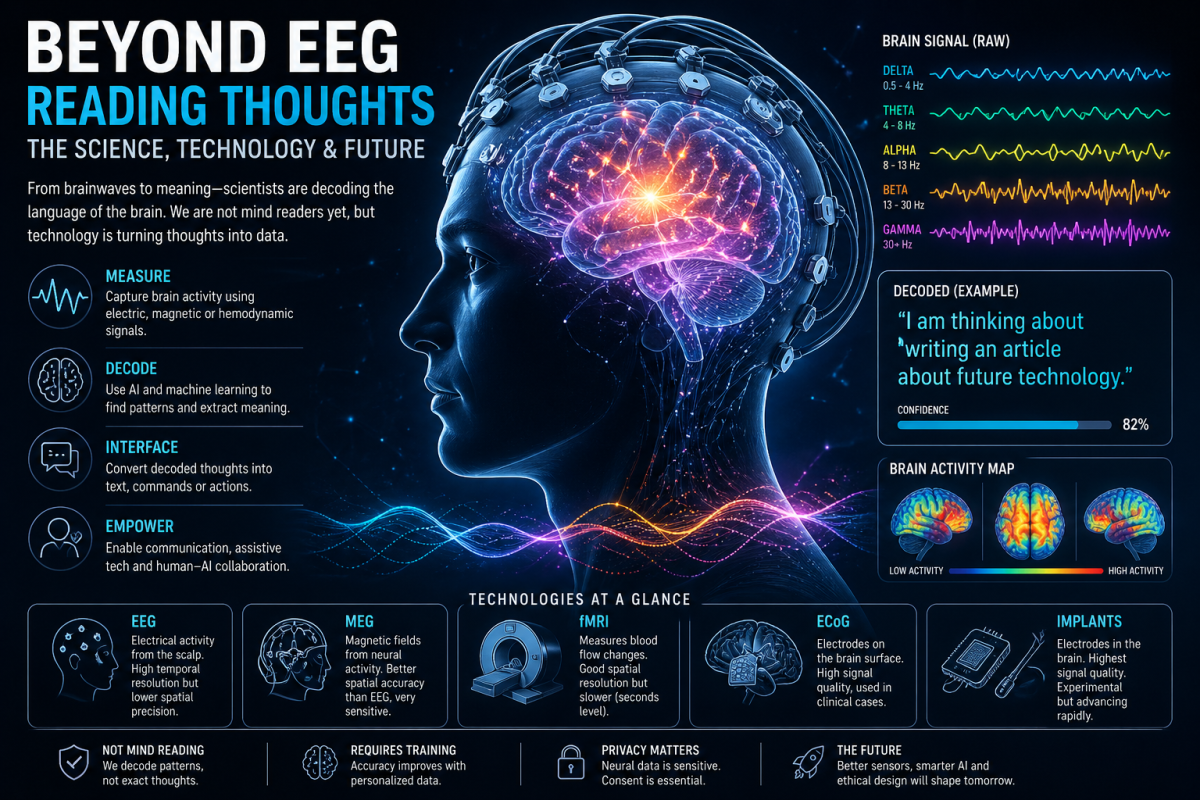
These patterns can appear as electrical waves, magnetic fields, blood-flow changes, or direct neural firing activity depending on the technology used.
2. EEG: The Basic Brainwave Reader
EEG, or electroencephalography, records electrical activity from the scalp. It is widely used in medicine, sleep studies, epilepsy diagnosis, and research.
EEG can show general brainwave patterns such as alpha, beta, theta, delta, and gamma activity. But EEG does not directly read thoughts. It gives a graph of brain activity, not a sentence, image, or private idea.
3. MEG: Reading the Brain’s Magnetic Fields
Magnetoencephalography, or MEG, measures the tiny magnetic fields produced by neural electrical activity. Unlike EEG, MEG detects the magnetic component of brain activity rather than the electrical voltage on the scalp.
MEG can provide cleaner spatial information than EEG because magnetic fields are less distorted by the skull. However, the signals are extremely weak and usually require expensive equipment, special sensors, and magnetically shielded rooms.
MEG cannot read thoughts through walls or from a distance. The brain’s magnetic fields are far too weak, and environmental noise would completely overwhelm the signal.
4. fMRI: Mapping Thought Through Blood Flow
Functional MRI does not measure electricity directly. Instead, it detects changes in blood flow associated with brain activity. When a brain region becomes active, it uses more oxygen, and fMRI can detect that change.
fMRI has been used in research to identify which brain areas are involved in language, memory, movement, emotion, and visual processing. With artificial intelligence, researchers have even reconstructed rough images or sentence meanings from brain activity.
But fMRI is slow, expensive, and impractical for everyday use. It is a powerful research tool, not a portable thought reader.
5. Brain-Computer Interfaces
Brain-computer interfaces, or BCIs, are the closest real-world technology to thought-controlled systems. A BCI captures brain signals and converts them into commands.
Examples include moving a cursor, selecting letters, controlling a robotic arm, or helping paralyzed patients communicate.
BCIs can be non-invasive, using EEG-like sensors, or invasive, using implants placed on or inside the brain. Invasive systems usually provide much stronger and clearer signals.
6. Can Thoughts Be Converted Into Text?
This is one of the most exciting areas of research. Scientists are working on systems that decode inner speech, imagined speech, or heard language from brain activity.
Some experimental systems can convert brain patterns into approximate words or sentences. These systems usually require training, controlled conditions, and advanced AI models.
They do not freely read random private thoughts. They infer likely meaning from patterns, context, and previous training data.
7. Why True Mind Reading Is Difficult
Human thoughts are not stored as simple text inside the brain. A thought may involve memory, emotion, language, sensory imagination, and personal associations all at once.
The same thought may produce different patterns in different people. Even in the same person, the pattern may change depending on mood, attention, fatigue, or context.
This makes true thought reading extremely difficult. Current systems are better described as neural pattern decoders, not mind readers.
8. The Physics Barrier
One major limitation is signal strength. Brain signals are very weak. The skull, skin, distance, and environmental interference all reduce signal quality.
For example, MEG signals are many billions of times weaker than the Earth’s magnetic field. That is why MEG systems need highly sensitive sensors and controlled environments.
Remote thought detection through walls is not realistic with current science. The signal would be too weak and too distorted to decode meaningfully.
9. Future Expectations
The future of brain-reading technology will likely move in three directions: better sensors, stronger AI models, and safer human-machine interfaces.
Short-Term Future
In the next several years, we may see better wearable EEG devices, improved assistive communication systems, and more accurate brain-controlled computer interfaces.
Medium-Term Future
Over the next decade or two, brain-to-text systems may become more practical for patients with paralysis, speech loss, or severe motor disabilities.
Long-Term Future
In the distant future, direct communication between the brain and AI systems may become possible in limited forms. People may control computers, compose text, or interact with digital systems using neural signals.
However, full unrestricted mind reading remains unlikely without major breakthroughs in neuroscience, signal detection, and ethical regulation.
10. Ethical Concerns
As brain-decoding technology improves, privacy will become a major issue. Neural data is deeply personal. It may reveal attention, intention, emotional state, or health information.
Future laws may need to protect mental privacy, require consent for neural data collection, and prevent misuse by employers, governments, advertisers, or security agencies.
Conclusion
We are not yet living in an age of true mind reading. But we are entering an age where brain signals can be measured, interpreted, and connected to machines in increasingly powerful ways.
The most realistic future is not secret mind reading through walls. It is controlled, consent-based brain-computer communication, especially for medicine, accessibility, and human-computer interaction.
The human brain may never become an open book, but it is becoming a new kind of interface.