

Kundalini Awakening: Complete Guide to Energy, Chakras, Symptoms, Risks, and Safe Ascension
Introduction
Kundalini awakening is a profound and complex inner process described in the spiritual traditions of Hinduism, Tantra, and certain Buddhist systems. It refers to the activation of a dormant primal energy within the human body, traditionally said to reside at the base of the spine.
This process is often associated with deep psychological transformation, intense physical sensations, altered states of consciousness, and spiritual realization. However, while often idealized as a path to enlightenment, Kundalini awakening can also be destabilizing if not approached with preparation and understanding.
This article provides a complete and detailed exploration, covering the traditional concept of Kundalini, the chakra system and energy movement, the full spectrum of symptoms, risks and Kundalini crisis, step-by-step awakening process, the danger of bypassing foundational stages, and scientific interpretation.
What is Kundalini Awakening?
Kundalini, from kundal, meaning “coiled” or “spiraled,” is a concept originating in tantric yoga and the esoteric traditions of Hinduism and Buddhism. It refers to a primal energy said to reside at the base of the spine, usually described as being “coiled” three and a half times like a serpent, dormant within the Muladhara, or Root Chakra.
A Kundalini awakening is the process by which this dormant energy is stimulated and begins to rise up the Sushumna Nadi, the central energetic channel, passing through the major chakras along the spine.
The ultimate goal, in many traditions, is for the energy to reach the Sahasrara, or Crown Chakra, leading to profound transformation, expanded consciousness, and a state of enlightened awareness or samadhi.
The Chakra System: Energy Centers Explained
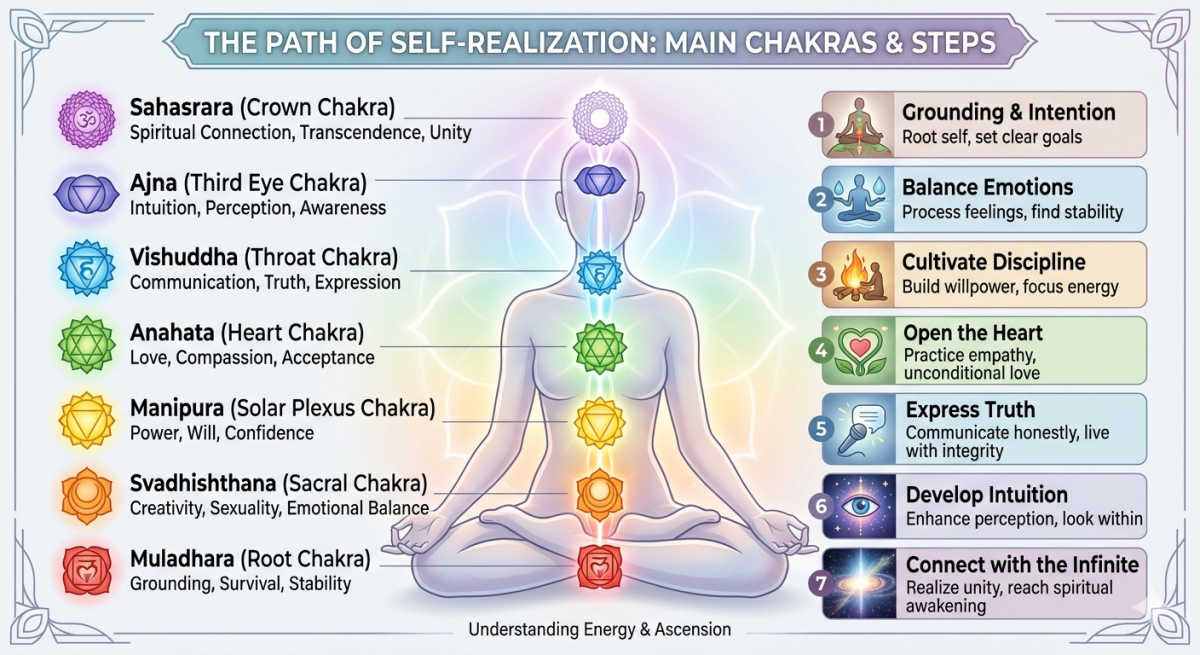
As Kundalini rises, it passes through seven major chakras. These chakras are traditionally understood as energy centers, but in modern interpretation they can also be seen as symbolic models representing different layers of human experience: survival, emotion, willpower, compassion, expression, intuition, and spiritual unity.
- Muladhara (Root): Stability, survival.
- Swadhisthana (Sacral): Creativity, emotions, sexuality.
- Manipura (Solar Plexus): Willpower, personal power.
- Anahata (Heart): Love, compassion.
- Vishuddha (Throat): Communication, expression.
- Ajna (Third Eye): Intuition, perception.
- Sahasrara (Crown): Spiritual connection, transcendence.
Signs and Symptoms of a Kundalini Awakening
A Kundalini awakening can manifest in a wide range of intense physical, emotional, mental, and spiritual symptoms. These can appear gradually or suddenly, and the experience varies greatly from person to person.
Physical Sensations
Involuntary Movements: Kriyas, meaning spontaneous jerking, trembling, or shaking of the limbs or body, spasming, or unusual muscle contractions.
Intense Heat or Cold: Feelings of extreme warmth, sometimes called the “inner fire,” or profound coldness spreading through the body or traveling up the spine.
Tingling or Electricity: Unusual sensations like electricity, current, or intense tingling “creeping” along the skin or within the limbs.
Pressure: Pressure or tension felt in the head, spine, face, or chest.
Pains/Discomfort: Spontaneous aches, sharp pains, or localized discomfort that seem to arise without a physical injury.
Sensory Heightening: Acute sensitivity to light, sound, smell, and even thought.
Emotional and Psychological Signs
Intense Mood Swings: Alternating periods of profound peace and sudden, overwhelming sadness, fear, anxiety, or anger.
Vivid Dreams/Visions: Unusually vivid, symbolic, or clear dreams and visionary experiences.
Heightened Sensitivity: Deep empathy or a powerful response to emotions, one’s own or others’.
Derealization/Depersonalization: Temporary feelings of detachment from oneself or the surroundings, feeling “unreal.”
Psychological Crises: A deep questioning of reality, self-identity, and existence, sometimes referred to as the “dark night of the soul.”
Spiritual Signs
A-Ha Moments: Intense insights or sudden understandings about spiritual truths, connection, or reality.
Heightened Intuition: Development or intensification of intuitive abilities or “psychic” phenomena.
Mystical Experiences: Moments of oneness with all creation, deep inner stillness, or encounters with intense bliss.
Changes in Worldview: A profound shift in life values, beliefs, and perceptions.
Potential Risks and Challenges
While often sought as a pinnacle of spiritual experience, a Kundalini awakening is powerful and can be extremely destabilizing. In traditions where this energy is studied, it is handled with immense respect and care.
The Kundalini Crisis
An abrupt or unguided awakening can sometimes overwhelm the practitioner’s body, nervous system, and mind, a state sometimes called a “spiritual emergency” or “Kundalini psychosis.” This can resemble symptoms of intense psychological distress, such as:
- Panic attacks or debilitating anxiety.
- Intense confusion and disorganized thinking.
- Visual or auditory hallucinations.
- Inability to function in daily life.
- Severe physical discomfort.
These challenges often arise when the energy encounters blockages within the chakras or the nadis, or when the individual’s system is not “prepared” to hold the high-voltage energy. It is for this reason that many teachers emphasize a strong foundation in ethical living, physical practices, and breathwork before pursuing direct Kundalini stimulation.
Benefits of an Integrated Awakening
When Kundalini energy flows smoothly and is integrated healthily, the experiences can lead to transformation and healing.
Expanded Consciousness: Profound understanding of oneself, reality, and interconnection.
Deep Personal Healing: The surfacing and subsequent release of deeply stored trauma or karmic imprints.
Increased Vitality and Energy: Feeling a renewed sense of life force, clarity, and creativity.
Deepened Compassion: A natural arising of love and understanding for all beings.
Stable Inner Peace: A sense of equanimity and contentment that is less affected by external circumstances.
Guidance and Process: How to Start from Each Chakra and Reach Sahasrara
The process of Kundalini awakening is traditionally understood as a journey of purifying and balancing each energy center sequentially. The goal is not to force energy upward but to prepare the body, mind, emotions, and awareness so that higher states can be integrated safely.
1. Muladhara (Root Chakra)
Focus: Grounding and stability.
Action: Practice grounding exercises, such as walking barefoot, mindful standing, or mountain pose.
Process: Set a clear intention and root yourself in the physical world to create a safe foundation for the energy to rise.
2. Svadhisthana (Sacral Chakra)
Focus: Creativity and emotional balance.
Action: Engage in creative activities and fluid physical movements such as hip-opening yoga poses.
Process: Process your feelings and find emotional stability to ensure the energy is not blocked by repressed trauma.
3. Manipura (Solar Plexus Chakra)
Focus: Power, will, and confidence.
Action: Practice core-strengthening exercises and controlled breathwork. Strong breath practices should be learned carefully and not forced.
Process: Cultivate discipline and focus your energy to build the inner willpower necessary for the ascent.
4. Anahata (Heart Chakra)
Focus: Love, compassion, and acceptance.
Action: Practice loving-kindness meditation and chest-opening poses.
Process: Open the heart by practicing empathy and unconditional love for yourself and others.
5. Vishuddha (Throat Chakra)
Focus: Communication and truth.
Action: Chanting, singing, or journaling your honest thoughts.
Process: Express your truth by communicating honestly and living with integrity.
6. Ajna (Third Eye Chakra)
Focus: Intuition, perception, and awareness.
Action: Meditation focusing on the space between the eyebrows and visualizing deep indigo light.
Process: Develop intuition and enhance your perception by looking inward.
7. Sahasrara (Crown Chakra)
Focus: Spiritual connection, transcendence, and unity.
Action: Silent meditation and deep contemplation of the infinite.
Process: Connect with the infinite to realize unity and reach a state of spiritual awakening.
What Happens If One Tries to Reach Sahasrara Without Practicing the Other Chakras?
Reaching the Sahasrara, or Crown Chakra, without establishing a foundation through the lower chakras is generally cautioned against in traditional practices due to the risk of psychological and physical instability.
Potential Harm and Risks
Stimulating the crown chakra while the lower energy centers remain blocked or unpurified can lead to a state often described as a “spiritual emergency” or “Kundalini crisis.”
System Overload: The energy can overwhelm a nervous system that has not been prepared through ethical living, physical practice, emotional regulation, and breathwork.
Psychological Distress: Abrupt awakening without grounding can cause intense confusion, disorganized thinking, and an inability to function in daily life.
Mental Instability: Symptoms may resemble psychological crises, including panic attacks, debilitating anxiety, or visual and auditory hallucinations.
Physical Discomfort: When energy encounters blockages in the lower nadis or channels, it can result in sharp pains, involuntary movements, or extreme heat and cold.
Derealization: One may experience a detachment from reality or self-identity, feeling “unreal” because the root foundation has not been secured.
Benefits of an Integrated Approach
In contrast, an integrated awakening, where each chakra is balanced sequentially, allows the energy to flow smoothly and produce transformative benefits.
Stable Peace: A sense of equanimity that remains steady regardless of external circumstances.
Expanded Consciousness: A profound understanding of reality and interconnection without the accompanying terror or confusion of a crisis.
Personal Healing: The healthy surfacing and release of deep trauma rather than an overwhelming flood of emotional distress.
Increased Vitality: A renewed sense of life force and clarity rather than physical exhaustion or pain.
Traditional guidance emphasizes that the Muladhara, or Root Chakra, provides the necessary stability and survival foundation required before the energy reaches the state of enlightened awareness in the Sahasrara.
Scientific Fact-Check: What Can and Cannot Be Verified
Kundalini awakening is primarily a spiritual and subjective experience. Some aspects overlap with measurable psychological and physiological processes, while other claims remain outside current scientific verification.
What Has Some Scientific Support
Meditation and Brain Function: Meditation and contemplative practices have been studied for their effects on attention, emotional regulation, stress reduction, and brain plasticity.
Breathwork and Nervous System Regulation: Controlled breathing can influence autonomic nervous system activity, including stress response, heart rate variability, and emotional regulation.
Spiritual Emergency: Psychology and transpersonal studies have discussed intense spiritual experiences that can resemble crisis states, especially when the person is overwhelmed or unsupported.
What Is Not Scientifically Proven
Direct Measurement of Kundalini Energy: There is no widely accepted scientific instrument that directly measures Kundalini as an objective physical energy.
Chakras as Physical Organs: Chakras are not recognized as anatomical organs in modern medicine. They are better understood as traditional symbolic or psycho-spiritual models.
Electromagnetic Claims: Claims that Kundalini awakening produces unique measurable electromagnetic emissions are not established as mainstream scientific fact.
Important Safety Note
If someone experiences intense anxiety, hallucinations, inability to sleep, inability to function, severe physical symptoms, or frightening perceptual changes, it is important to seek qualified medical or mental health support. Spiritual interpretation and medical care do not have to oppose each other. A person can respect the spiritual meaning of the experience while also protecting their health and safety.
Conclusion
Kundalini awakening is a powerful concept that sits at the intersection of spirituality, psychology, body experience, and consciousness. Traditionally, it is described as the rise of dormant energy from the Root Chakra to the Crown Chakra, passing through the seven major chakras and transforming the practitioner at every level.
However, Kundalini awakening should not be treated as a shortcut to enlightenment. The process requires grounding, emotional maturity, discipline, compassion, truthful expression, awareness, and integration. Attempting to force the process or bypass the lower chakras can lead to confusion, fear, physical discomfort, and psychological instability.
The safest understanding is this: Kundalini is not only about rising upward. It is about becoming stable enough, clear enough, and integrated enough to hold expanded awareness without losing balance.
Preparation, grounding, and integration are not optional. They are the foundation of the path.
Bibliography and Further Reading
- Grof, S., & Grof, C. (1989). Spiritual Emergency: When Personal Transformation Becomes a Crisis.
- Sannella, L. (1987). The Kundalini Experience: Psychosis or Transcendence?
- Lukoff, D., Lu, F. G., & Turner, R. (1998). Research on spiritual problems and transpersonal psychology.
- Woollacott, M., & Kason, Y. (2020). Research on spiritually transformative experiences and Kundalini awakening.
- Goswami, S. S. (1980). Layayoga: The Definitive Guide to the Chakras and Kundalini.
Meta Description
Complete and detailed guide to Kundalini awakening, including chakras, physical and psychological symptoms, risks, spiritual emergency, scientific fact-checking, and safe practice.
Social Post Description
Kundalini awakening explained in full detail: what it is, how it moves through the chakras, possible signs, risks, benefits, and why grounding is essential before reaching higher consciousness.
Midjourney Image Prompt
Title: Kundalini Energy Rising Through the Chakras
meditating human figure, glowing chakra points along the spine, radiant serpent-like energy rising from root chakra to crown chakra, cosmic background, sacred geometry, soft spiritual light, detailed symbolic illustration, no text, cinematic composition --ar 16:9
Infographic Ideas
- Seven-chakra vertical ascension diagram.
- Physical, emotional, psychological, and spiritual signs of Kundalini awakening.
- Safe integrated awakening versus premature crown activation.
- Kundalini crisis warning signs and support steps.
- Traditional chakra model versus modern psychological interpretation.
WordPress Tags
Kundalini, Chakras, Meditation, Spiritual Awakening, Consciousness, Yoga, Spiritual Emergency, Energy Healing, Mind Body Connection
Categories
Spiritual Science, Health & Mind, Yoga & Meditation